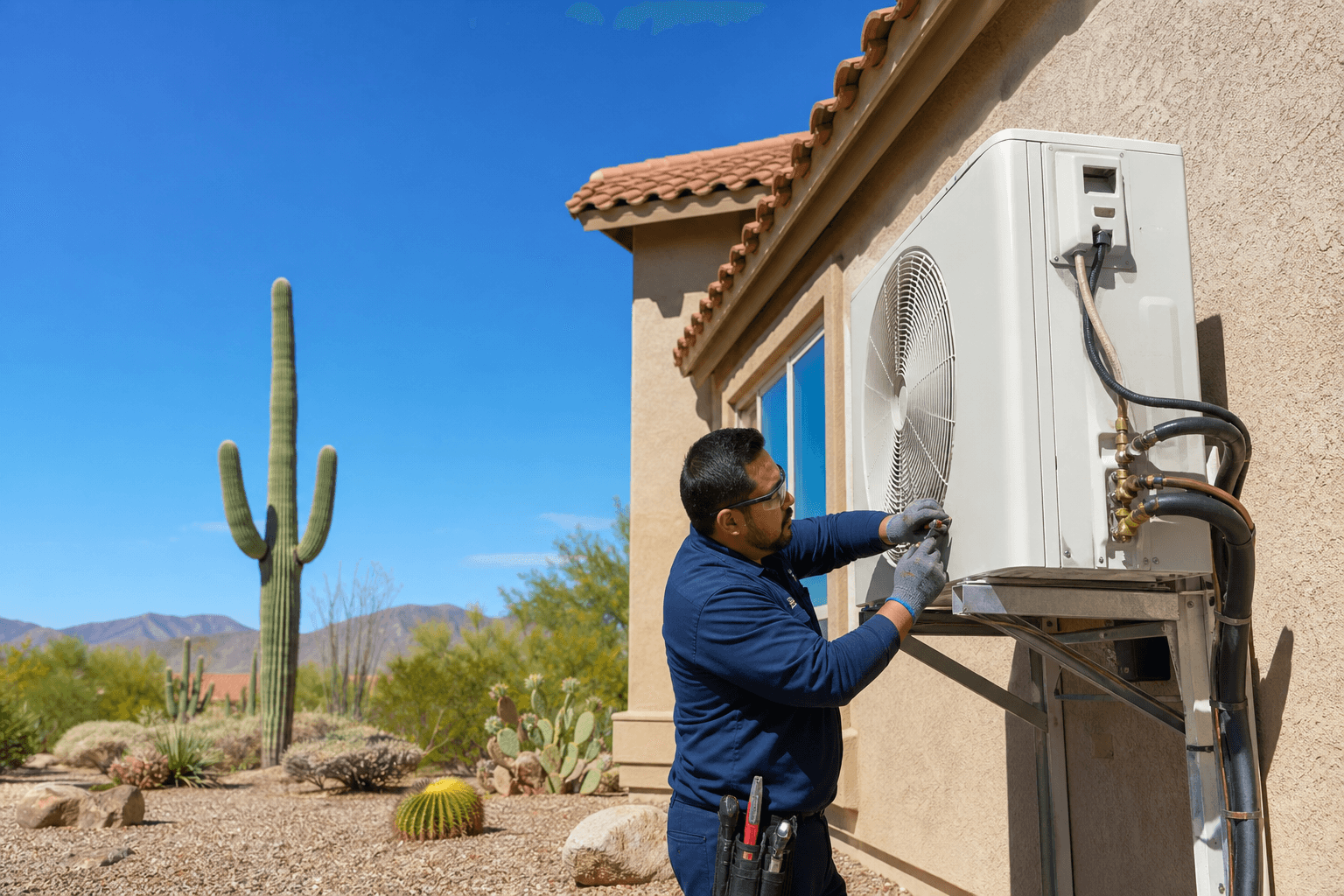
AC Installation & Repair in Phoenix, AZ
Fast, honest air conditioning installation, repair, and replacement in Phoenix, AZ, with upfront pricing and no hidden fees.
2,400+ happy customers across Phoenix
2,400+
AC Jobs Completed
12 Yrs
Serving Phoenix
4.9★
Star Rating
24/7
Emergency Service
What We Do
AC Services in Phoenix
From brand-new installs to emergency repairs, Phoenix Air Conditioning Pros handles every AC job in the Phoenix Valley.
AC Installation
New system, new home, or replacing old equipment — we handle full AC installations from start to finish. Same-day quotes, licensed techs, and upfront pricing.
AC Repair
AC stopped cooling? We diagnose and fix all makes and models — same day. From refrigerant leaks to blown capacitors, our techs have seen it all.
AC Replacement
Old system breaking down every summer? We'll help you pick the right unit for your home, pull the permits, and get it running fast.
AC Tune-Up & Maintenance
A $99 tune-up now beats a $2,000 repair in July. We clean coils, check refrigerant, test capacitors, and make sure your system runs at peak efficiency all summer.
Emergency AC Repair
When the AC dies at midnight in 110° Phoenix heat, you need someone now. We run true 24/7 emergency service with no after-hours markup on labor.
Mini-Split Installation
Perfect for garages, add-ons, and homes without ductwork. We install Mitsubishi, Daikin, and LG ductless systems with full manufacturer warranty.
Central Air Conditioning
We design and install complete central AC systems for Phoenix homes — from sizing the unit to running new ductwork. One crew, one job, done right.
Ductwork Installation & Repair
Leaky or undersized ducts make even a new AC work twice as hard. We install, seal, and repair ductwork to maximize airflow and cut your energy bill.
Smart Thermostat Installation
Cut cooling costs by 20% without touching the comfort. We install Nest, Ecobee, and Honeywell smart thermostats — programmed and ready to go before we leave.
AC System Inspection
Buying a home or not sure why your bill is high? Our 21-point AC inspection gives you a full picture of your system's health with no surprises.
Why Phoenix Calls Us
Honest work. Fair prices. Air conditioning service done right the first time.
Phoenix summers are brutal. When your AC goes down, you don't want to wait three days for a tech or get hit with a bill full of hidden charges. At Phoenix Air Conditioning Pros, we show up fast, tell you exactly what's wrong, and fix it for a price you agreed to upfront.
- Licensed, bonded & insured in Arizona
- Same-day & next-day availability
- Upfront flat-rate pricing — no surprise fees
- All major brands serviced
- Free second opinions
- Financing options available
4.9 star rating
How It Works
AC service shouldn't be complicated
Call or request a quote
Tell us what's going on. We'll schedule you for same-day or next-day service in most of the Phoenix Valley.
We diagnose & quote you
A licensed tech arrives on time, runs a full diagnostic, and gives you a flat-rate price before touching anything.
We fix it. You're cool.
Once you approve the work, we get it done — usually in a single visit. You pay what we quoted, nothing more.
Technical Knowledge
What every Phoenix homeowner should know about air conditioning
We believe an informed customer makes better decisions. Here's the technical context behind the work we do — straight from the techs who do it.
SEER2 Ratings Explained
SEER2 (Seasonal Energy Efficiency Ratio) measures how efficiently your AC converts electricity to cooling over an entire season. As of January 2023, the federal minimum for Arizona is 15.2 SEER2. A 16 SEER2 unit uses roughly 25% less electricity than a 13 SEER unit from 10 years ago. In Phoenix — where AC runs 8+ months a year — that difference on your APS or SRP bill adds up to hundreds of dollars annually. We always show you the efficiency payback math before you decide.
Manual J Load Calculations
Correct system sizing is the most important factor in AC performance — more important than brand, more important than SEER rating. A Manual J load calculation accounts for your home's square footage, ceiling height, insulation R-value, window area and orientation, local design temperature, and infiltration rate. Phoenix's design temperature (the 99th percentile outdoor temp) is 110°F. Skipping this step and just matching the old unit's tonnage is how techs produce oversized systems that short-cycle and leave homes humid.
Refrigerant: R-410A, R-32 & R-454B
R-410A — the refrigerant in most systems installed before 2025 — is being phased out under EPA rules due to its high global warming potential. New residential equipment manufactured after January 2025 uses lower-GWP refrigerants like R-454B (Puron Advance) or R-32. If your system uses R-410A, it can still be serviced and recharged — the refrigerant hasn't been banned, just production of new equipment is phased out. We stock both and can service any system. Replacement units from all major brands have already transitioned to the new refrigerants.
Single-Stage vs. Two-Stage vs. Variable-Speed
Single-stage compressors run at 100% or off — fine for mild climates, but in Phoenix they cycle constantly during shoulder months and struggle on peak summer days. Two-stage systems run at 65–70% capacity most of the time, cycling to full power only when needed, which dramatically improves humidity control and efficiency. Variable-speed (or inverter-driven) compressors modulate continuously from roughly 25% to 100%, delivering the most precise temperature control, the lowest operating cost, and the quietest operation. They cost more upfront and typically pay back in 4–7 years in Phoenix's climate.
Common AC Failure Points in Phoenix Heat
Phoenix's extreme heat accelerates specific failure modes that techs in milder climates rarely see. Capacitors — the components that start and run the compressor and fan motors — fail far more frequently here because they operate at sustained high temperatures. Contactors oxidize faster. Condenser fan motors overheat. Refrigerant leaks at brazed connections expand under thermal cycling stress. Our vans stock capacitors, contactors, and fan motors for the most common systems because these are the repairs we run on every week of every summer.
Electrical Requirements for AC Installation
Most central AC systems require a dedicated 240V circuit with a disconnect box within sight of the unit, plus a properly sized breaker — typically 30A to 60A depending on tonnage. Mini-splits vary from 15A (small single-zone) to 50A+ (multi-zone). If your panel is older or already loaded, we evaluate capacity before installation and will coordinate with a licensed electrician if a panel upgrade is needed. We don't cut corners on electrical — it's both a code requirement and a fire risk.
Brands We Install & Service
AC Brand Comparison for Phoenix Homeowners
Every brand has real strengths and trade-offs. Here's our honest take — the same comparison we give customers on the job.
Trane
Known for: Reliability
Trane is the benchmark for reliability in the HVAC industry. Their compressors — particularly the Climatuff — are engineered to handle sustained high heat. They carry some of the industry's longest standard warranties and have a massive service network. Trane XR and XV series are consistently rated best-in-class for longevity. The trade-off: they're typically 10–20% more expensive than comparable Rheem or Goodman units. For Phoenix homeowners who want to install once and not think about it again, Trane is the most common recommendation.
Carrier
Known for: Legacy & Innovation
Carrier invented modern air conditioning in 1902 and has been at the front of the industry ever since. Their Infinity series offers some of the best variable-speed technology available, with SEER2 ratings up to 26. Carrier's Greenspeed Intelligence technology allows their top-tier units to modulate in very fine increments, delivering exceptional comfort in extreme heat. Mid-range Carrier units (Performance series) offer solid reliability at a more accessible price point. Carrier and Trane are owned by the same parent company and share manufacturing standards.
Lennox
Known for: Efficiency
Lennox holds the efficiency crown — their XC25 achieves up to 28 SEER2, the highest available in residential equipment. If your household runs the AC heavily and you're on an APS or SRP tiered rate plan, a Lennox premium unit can deliver a faster payback than any other brand. The trade-off is that Lennox uses more proprietary parts than Trane or Carrier, which can make out-of-warranty repairs slightly more expensive and limits which technicians can service them. Best fit for high-energy-use Phoenix homes where the efficiency math justifies the premium.
Goodman
Known for: Value
Goodman (now owned by Daikin) offers one of the best price-to-reliability ratios in the industry. They're manufactured in Houston and are one of the most common brands installed in Phoenix new construction. Goodman units are straightforward to service, parts are widely available, and they carry a 10-year parts warranty when registered. They won't match Trane or Carrier on raw durability, but for budget-conscious homeowners or rental properties, Goodman delivers solid performance at 20–30% lower cost. Their DSXC18 is a strong mid-efficiency choice for Phoenix.
Rheem
Known for: Reliability + Value
Rheem sits comfortably between Goodman's value pricing and Trane/Carrier's premium tier. They manufacture both their air conditioners and heat pumps in the US and have a strong service network across the Southwest. Rheem's Prestige series (up to 20 SEER2) hits a sweet spot for Phoenix homeowners who want better-than-basic efficiency without the premium brand price. Parts availability is excellent and technician familiarity with Rheem is high across the Valley. A reliable pick at a fair price.
American Standard
Known for: Reliability
American Standard and Trane are made by the same company (Trane Technologies) in the same facilities to the same specifications. The primary difference is the dealer network — American Standard is sold exclusively through independent dealers, often resulting in more personalized service. If you get a quote for American Standard and a Trane quote side by side, compare specs carefully — you'll likely find the equipment is nearly identical. A strong choice if your local American Standard dealer offers better installation quality or service terms.
Mitsubishi
Known for: Ductless / Mini-Splits
Mitsubishi Electric is the gold standard for ductless mini-split systems. Their Hyper-Heating (H2i) technology and Diamond Contractor certification program are benchmarks the industry measures against. For Phoenix, their MXZ multi-zone and MSZ single-zone wall-mount systems are the most reliable ductless options available. Mitsubishi's inverter-driven compressors are among the most durable in the business and their SEER2 ratings regularly top 20+. If you're adding a garage, casita, or room addition without ductwork, Mitsubishi is the recommendation without hesitation.
Daikin
Known for: Ductless + Central
Daikin is the largest HVAC manufacturer in the world and has made significant investments in the US market since acquiring Goodman in 2012. Their ductless mini-split lineup competes directly with Mitsubishi at a slightly lower price point and their central AC systems share Goodman's strong value proposition. Daikin's Fit system is a notable innovation — a side-discharge unit that requires less clearance than traditional condenser designs, useful in tight Phoenix side yards. A strong brand at every tier from economy to premium.
Not sure which brand is right for your home?
We'll give you an honest side-by-side comparison based on your home's size, your energy goals, and your budget — at no charge.
Phoenix Heat Facts
Why Phoenix is the hardest city in America on air conditioning equipment
Phoenix averages 299 sunny days per year and regularly records June, July, and August highs above 110°F. The design temperature used for HVAC calculations — the 99th percentile outdoor high — is 110°F for the Phoenix metro. For comparison, Dallas is 100°F. Los Angeles is 95°F. Atlanta is 94°F.
That 10–15 degree difference is enormous for AC equipment. Condenser coils work by rejecting heat from inside your home to the outdoors — the hotter the outdoor air, the harder that process becomes. Equipment that runs fine in Texas will work at or near its limits on a Phoenix summer afternoon.
Phoenix also runs AC for roughly 8 months of the year — April through October at minimum. That's twice the annual runtime of systems in the Midwest or Northeast. Higher runtime means faster component wear, more frequent capacitor failures, and a shorter average equipment lifespan than the national average. This is why annual maintenance in Phoenix isn't optional — it's genuinely necessary.
110°F
Phoenix design temperature
vs. 94–100°F in most Sun Belt cities
8 mo.
Average cooling season
vs. 4–5 months in most of the US
299
Sunny days per year
Maximum solar heat gain on roofs and walls
2–3×
Faster component wear
Capacitors, contactors, fan motors
Transparent Pricing
What does AC service cost in Phoenix?
Real price ranges for common services — because you shouldn't have to call five companies just to get a ballpark number. Every job gets a flat-rate quote before we start.
Prices shown are typical ranges for the Phoenix metro. Final price depends on system size, brand, access complexity, and current material costs. You will always receive a flat-rate written quote before any work starts.
Common Questions
Air conditioning questions we get every week in Phoenix
How long does AC installation take in Phoenix?
What size AC unit do I need for my Phoenix home?
Is it worth repairing my old AC or should I replace it?
What brands do you install and service?
Do you offer financing for AC installation?
How often should I service my AC in Phoenix?
Do you pull permits for AC installation in Phoenix?
What is the minimum SEER rating for Arizona?
Service Area
Air conditioning services for the Greater Phoenix Area
We run daily air conditioning service calls across the entire Valley — from north Scottsdale to Goodyear and everywhere in between. Same-day availability in most zip codes.
Phoenix
All Phoenix zip codes, central and surrounding neighborhoods
Scottsdale
Old Town to north Scottsdale, McDowell Mountain area
Mesa
Dobson Ranch, Red Mountain, Superstition Springs
Tempe
ASU area, Tempe Town Lake, South Tempe
Chandler
Downtown Chandler, Ocotillo, Fulton Ranch
Gilbert
San Tan Village, Val Vista Lakes, Power Ranch
Glendale
Westgate, Arrowhead, Peoria Ave corridor
Peoria
Vistancia, P83, Lake Pleasant Parkway
Surprise & Goodyear
Sun City Grand, Marley Park, Estrella Mountain Ranch
Don't see your city? Call us — we likely cover it.
View All Service AreasAC acting up? Don't sweat it — call us now.
Free quotes, same-day service, and upfront pricing every time. We're the Phoenix AC pros.